
The Complete Guide to Custom Event Signage for Trade Shows and Outdoor Promotions
A sign does not work in isolation.
At a trade show, visitors see it behind counters, beside monitors, between staff members, and against graphics from nearby exhibitors. At an outdoor event, the same design competes with tents, sponsor boards, vehicles, trees, sunlight, and people moving in several directions.
That is why effective custom event signage should be planned around the way visitors actually approach, view, and use the event space.
Your signage system should help people:
-
Locate your booth or promotional area
-
Recognize what your business offers
-
Decide whether the offer is relevant
-
Find the correct product or activity zone
-
Take the next step without asking for directions
The goal is not to place your logo on every available surface. The goal is to give each sign a specific job.
Start With the Visitor Route Before Choosing Any Sign
It is tempting to begin with products.
You may already be thinking about a banner stand, an A-frame, a feather flag, or a printed canopy. But before choosing the hardware, look at how people will move through the venue.
Where will they first see you? Which direction will they approach from? What will block their view?
A sign that looks impressive from the front may contribute very little when most visitors see it from the side.
Before ordering your event display signage, mark these areas on the event layout:
-
Main entrance and registration area
-
Primary and secondary aisles
-
Corners and aisle intersections
-
Food, seating, or refreshment areas
-
Product demonstration zones
-
Queue entrances and exits
-
Parking and pedestrian approaches
-
Competitor and sponsor locations
-
Areas where crowds may block lower signage
For a trade show booth, identify whether the space is:
-
Inline
-
Corner
-
Peninsula
-
Island
For an outdoor event, identify the ground surface:
-
Grass
-
Concrete
-
Asphalt
-
Sand
-
Indoor flooring
The traffic route tells you where signs should be placed. The surface tells you which base or mounting system will work there.
Give Every Sign One Main Job
When one sign tries to attract attention, explain the product, list every feature, provide directions, show certifications, and generate leads, the result becomes difficult to process.
A stronger approach is to assign one operational role to each piece of branded event signage.
Locator signage
This helps people find your brand before they reach the immediate booth area.
Common locator displays include:
-
Printed canopy roofs
-
Display towers
-
Elevated booth headers
Keep locator messages short:
-
Company name
-
Product category
-
Short campaign phrase
-
Directional cue
Interceptor signage
This gives passing visitors a reason to slow down.
Useful formats include:
-
Outdoor pop-up displays
-
Signs placed at booth corners
An interceptor should lead with a specific problem, result, or offer.
Instead of writing:
Welcome to Apex Technology
You can write:
Still Losing Orders to Inventory Errors?
The second version creates a reason to stop.
Qualifier signage
This helps visitors decide whether the product or service applies to them.
A qualifier can communicate:
-
Industry served
-
Product application
-
Service area
-
Available size range
-
Compatibility
-
Purchase level
-
Installation type
-
Intended environment
For example:
Custom Printed Tents for Farmers Markets, Food Vendors, and Festival Sponsors
This filters the audience before your sales team begins the conversation.
Proof signage
Proof signage supports the claim made elsewhere in the display.
Use:
-
Real application photography
-
Customer logos
-
Certifications
-
Measurable results
-
Installation examples
-
Product comparisons
-
Before-and-after images
Conversion signage
This tells the visitor what to do next.
Examples include:
-
Scan to compare packages
-
Ask about show pricing
-
Book a demonstration
-
Request a printed sample
-
Join the giveaway
-
Get a custom booth quote
Each zone should have one primary action. Several competing calls to action can slow the visitor down instead of moving them forward.
Build the Message in the Same Order Visitors Think
Visitors do not need every detail immediately.
They need the right information in the right sequence.
A strong custom event signage system usually follows five stages.
1. Category
Tell visitors what you sell.
Commercial Water Filtration Systems
2. Outcome
Explain the result your product provides.
Reduce On-Site Water Costs Without Permanent Installation
3. Fit
Show who the solution is built for.
For Construction Sites, Mobile Facilities, and Temporary Operations
4. Proof
Support the claim with evidence.
Use:
-
Test results
-
Certifications
-
Product photography
-
Client logos
-
Installation data
5. Action
Tell the visitor what to do next.
Scan to Calculate Your System Requirements
This sequence helps booth staff start deeper conversations.
Instead of asking, “Have you heard of us before?” they can ask something directly related to the visitor’s situation.
For example:
“What type of site are you planning to use this system for?”
That is a much stronger starting point.
Plan Trade Show Signage Around the Booth Type
Different booth configurations create different sightlines.
A signage system that works in a 10×10 inline booth may underperform in a 20×20 island space.
For a 10×10 inline booth
Visitors usually approach from one front aisle. Neighboring booths block the side views, so the backwall and front corners do most of the work.
Use:
-
A category or outcome statement high on the backwall
-
One aisle-facing banner stand
-
A focused counter graphic
-
Product-level signs beside the relevant displays
-
One visible action near the booth entrance
Avoid placing a large floor sign directly in the center. It can block the entrance and make the booth feel harder to enter.
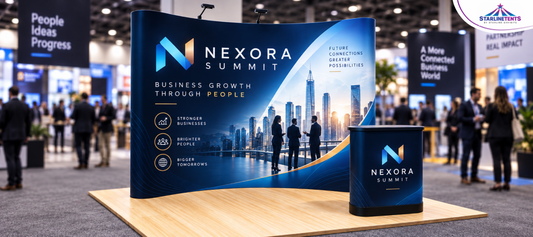
Starline Tents offers several banner stand options for aisle-facing messages, product introductions, and close-range calls to action.
For a 10×20 corner booth
A corner booth receives traffic from two directions.
Use each approach for a different but connected message.
For example:
-
Front aisle: product category
-
Side aisle: audience problem
-
Corner: double-sided or angled display
-
Interior wall: proof and application content
-
Counter area: consultation or quote request
Repeating the same tagline on both sides gives you more exposure but no additional information.
For a peninsula or island booth
Visitors can approach from three or four directions.
Use height to establish location, then use lower signage to divide the booth into zones.
Consider:
-
Overhead brand identification
-
Product-area banners
-
Demonstration signs
-
Consultation-zone signage
-
Directional signs between booth sections
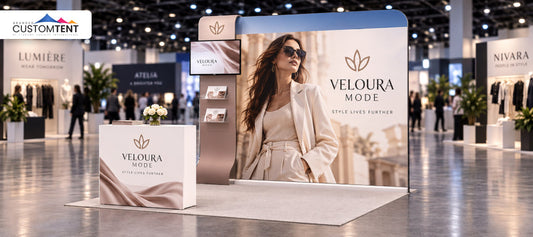
A custom hanging sign can identify the booth from several aisles, while the floor-level signs explain products, applications, and next steps.
Plan Outdoor Event Signage Around Environmental Interference
Outdoor promotions introduce factors that do not exist inside exhibition halls.
The sign may move in the wind. Sunlight may cross the graphic at different angles. Visitors may approach from a parking lot, vendor row, stage area, or open field.
Your outdoor event signage should be selected for those conditions, not adapted from an indoor plan at the last minute.
Review:
-
Sun direction throughout the day
-
Wind exposure
-
Ground surface
-
Viewing distance
-
Nearby tent colors
-
Trees and landscaping
-
Vehicle traffic
-
Crowd density
-
Rain or moisture exposure
-
Sponsor signage around the area
Use moving signs for short messages
Feather flags attract attention because they move.
That movement also reduces reading time.
Use them for:
-
Brand name
-
Product category
-
Direction
-
One short offer
-
Entrance identification
Do not place long sentences or detailed product information on a rotating flag.
Use stable signs for detailed information
A-frames, rigid boards, and weighted pop-up displays are better suited for:
-
Prices
-
Directions
-
Product differences
-
Instructions
-
Event schedules
-
QR codes
-
Promotional offers
The flag can attract the eye. The A-frame can finish the message.
Choose the base before approving the location
A ground spike works on grass but cannot be installed on concrete.
A water-filled base provides more stability but adds transport weight.
A large A-frame may work well in an open festival area but obstruct a narrow sidewalk.
Base options may include:
-
Ground spikes
-
Cross bases
-
Water-weight bags
-
Sandbags
-
Molded plastic bases
-
Steel feet
-
Weighted plates
The location and surface should determine the hardware.
Match the Message Load to the Viewing Distance
A sign viewed from 50 feet away cannot carry the same amount of information as one placed beside a product demonstration.
Use distance to control content density.
Long-range custom event signage
Use:
-
Brand name
-
Product category
-
One short outcome
-
Large logo
-
One dominant visual
Suitable formats include:
-
Hanging structures
-
Canopy roofs
-
Tall flags
-
Large backwalls
-
Elevated headers
Avoid:
-
Product specifications
-
Several photographs
-
Multiple QR codes
-
Small contact details
-
Long feature lists
Mid-range signage
Use:
-
Benefit-led headline
-
Short supporting statement
-
One proof point
-
Product or application image
-
One call to action
Suitable formats include:
-
Retractable banners
-
A-frames
-
Barricade covers
-
Canopy walls
-
Outdoor pop-up signs
Close-range signage
Use:
-
Product comparisons
-
Available sizes
-
Package differences
-
Technical information
-
Installation details
-
QR codes
-
Consultation prompts
Suitable locations include:
-
Counters
-
Product tables
-
Demonstration stations
-
Waiting areas
-
Registration desks
When detailed content is placed on a long-range sign, visitors cannot read it.
When a long-range message is repeated beside a product table, it gives interested visitors no additional information.
Do Not Repeat the Same Artwork on Every Surface
Repeating one design across a tent roof, backwall, table cover, flag, and A-frame may look coordinated in the artwork file.
At the event, it wastes space that could answer different visitor questions.
A better outdoor signage sequence might look like this:
Canopy roof
Fresh Roasted Coffee
Front valance
Roasted Locally Every Week
Feather flag
COFFEE
A-frame
Free Sample With Any Bag Purchase
Backwall
Single-Origin, Espresso, and Decaf Roasts
Table cover
Scan to Join the Monthly Coffee Club
Each surface adds new information while staying within the same brand system.
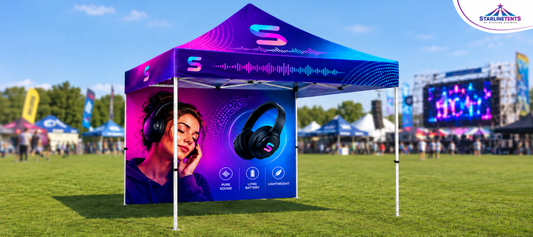
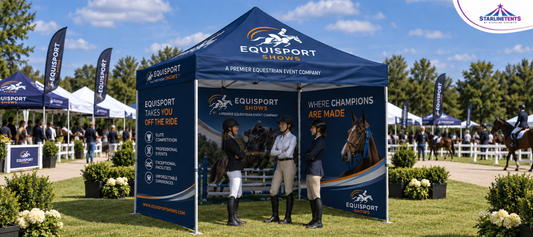
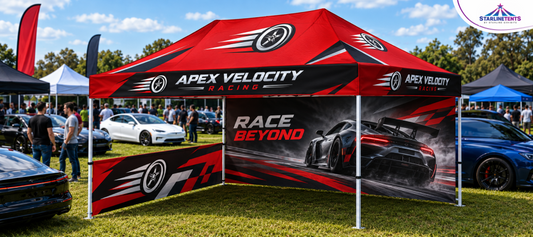
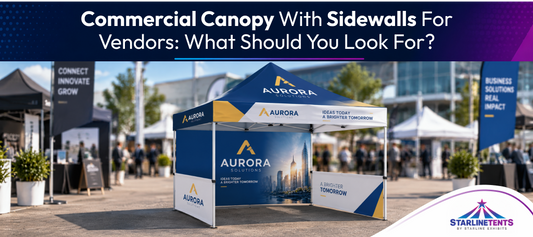
Starline Tents offers custom canopy tents in several footprints, allowing the roof, valance, backwall, sidewalls, and table graphics to work together as one promotional environment.
Design Around Real Obstructions
Graphics are usually reviewed as flat artwork.
But once installed, the sign may sit behind a counter, beside a monitor, under a canopy valance, or between staff members.
That changes which information remains visible.
Before printing, create a scaled event mockup that includes:
-
Counter height
-
Table width
-
Monitor position
-
Product placement
-
Brochure rack
-
Staff height
-
Tent openings
-
Flag shape
-
Barricade rails
-
Nearby furniture
Then divide the artwork into three zones.
Upper zone
Use this for information that must stay visible:
-
Product category
-
Main benefit
-
Brand identifier
Middle zone
Use this for:
-
Product image
-
Proof point
-
Supporting message
-
Secondary benefit
Lower zone
Use this for supporting design elements that can tolerate partial obstruction.
Avoid placing these items near floor level:
-
Primary call to action
-
Only QR code
-
Main product name
-
Directional arrow
-
Event offer
A QR code placed behind a counter is not simply less visible. It may become impossible to scan.
Choose Double-Sided Printing Only When Both Sides Serve a Purpose
Double-sided printing is useful for signs positioned between two traffic directions.
It is unnecessary when the rear graphic faces a wall, booth storage area, or staff-only space.
Before choosing double-sided production, ask:
-
Will visitors see both sides?
-
Does each side face a different stage of the visitor journey?
-
Should the messages be identical?
-
Does the reverse side need a different action?
-
Will the stand be moved between locations?
The two sides can also perform separate jobs.
Front side
Register Here for the Product Demonstration
Reverse side
Scan to Download the Specification Sheet
The arriving visitor sees the registration message.
The departing visitor sees the follow-up action.
One sign supports two separate points in the event experience.
Select Signage by Its Most Likely Failure Point
Do not compare products only by size and price.
Think about what could go wrong after repeated use.
Retractable banner stands
Check for:
-
Uneven graphic retraction
-
Weak support poles
-
Lightweight bases
-
Graphic curling
-
Glare across text
-
Damage during transportation
-
Limited replacement options
Use retractable stands when setup speed and compact transport are priorities.
A-frame signs
Check for:
-
Base movement
-
Incorrect traffic direction
-
Insufficient ballast
-
Artwork that is too detailed
-
Placement blocking entrances
-
Dirt reducing lower graphic visibility
Starline Tents offers Signicade A-frame options for entrances, registration areas, queues, sidewalks, and temporary promotions.
Feather flags
Check for:
-
Incorrect base
-
Text distortion
-
Excessive wording
-
Poor contrast with nearby tents
-
Flags rotating away from traffic
-
Logo placement near the curved edge
Use flags as visual markers rather than product brochures.
Outdoor pop-up displays
Check for:
-
Low visibility behind crowds
-
Shape conflicting with the artwork
-
Poor anchoring
-
Grass covering the lower graphic
-
Too many nearby sponsor signs
Barricade covers
Check for:
-
Text split across separate barriers
-
Small lettering
-
Important content hidden by queues
-
Unused rear-facing space
-
Graphics not aligned across multiple units
Starline Tents groups several of these formats within its outdoor signage collection.
Use Signage to Improve Sales Conversations
Your signs should help staff identify why a visitor stopped.
For example, a sign that reads:
Compare Our Three Commercial Tent Frame Levels
tells your sales team that the visitor may be evaluating durability, usage frequency, or price.
The conversation can begin with:
“How often will you be setting up the tent?”
That question leads directly into product selection.
A generic message such as:
Quality Event Solutions
does not reveal what interested the visitor.
Your staff must restart the entire discovery process.
Write custom promotional signs that naturally lead to a useful follow-up question.
Examples include:
-
Which size fits your event space?
-
See the difference between standard and heavy-duty frames
-
Need a tent for weekly outdoor use?
-
Compare single- and double-sided display options
-
Ask which base works on concrete
Connect Every QR Code to a Specific Promise
A QR code should not send visitors to a general homepage unless the sign specifically promises a homepage.
The destination should continue the exact message printed beside it.
Sign message
Scan to Compare 10×10 Tent Packages
Landing page
The first screen should show the package comparison.
Do not make visitors search for it again.
Create separate tracked links for:
-
Entrance A-frame
-
Canopy wall
-
Banner stand
-
Product display
-
Demonstration counter
-
Barricade cover
-
Exit signage
This shows which sign locations generated engagement.
It can also reveal when a sign attracts attention but fails to generate action.
Create a Modular Signage Kit for Different Events
You do not need completely new hardware for every promotion.
Keep the display systems and change the graphics according to the audience.
The same A-frame can support different messages:
Trade show
Ask About Distributor Pricing
Farmers market
Samples Available Today
Festival
Scan to View the Full Product Range
Dealer event
Book an Installation Consultation
Build a reusable design library containing:
-
Logo placement
-
Headline system
-
Product photography
-
Directional arrows
-
QR-code block
-
Proof-point layout
-
Call-to-action format
-
Sponsor panel
-
Event-specific color accents
This approach allows the campaign to change without replacing the full display system.
Review Visitor Behavior After the Event
Do not judge trade show signage only from booth photographs.
Track what visitors actually did.
Review:
-
Which direction generated the most entries
-
Which sign produced questions
-
Which QR code received scans
-
Which product area held attention
-
Which sign was regularly blocked
-
Which message visitors repeated
-
Which questions staff answered throughout the day
-
Which display was ignored
-
Which outdoor sign rotated or shifted
-
Which graphic reflected sunlight
Repeated questions show where information is missing.
For example, when visitors repeatedly ask whether a product can be used outdoors, the qualifier sign should probably include that information.
When people reach the counter and still cannot tell which product suits them, the booth may need a comparison sign before the consultation area.
Build Your Custom Event Signage Package With Starline Tents
A complete signage package should follow the event layout.
For trade shows, you may need:
-
An overhead locator
-
Aisle-facing banner stand
-
Product comparison graphic
-
Demonstration sign
-
Counter call to action
For outdoor promotions, you may need:
-
Printed canopy
-
Tall feather flags
-
A-frame offer sign
-
Outdoor pop-up display
-
Barricade graphics
-
Directional signage
Starline Tents offers several options across its event display range:
The right package may include only three or four products.
What counts is whether each one supports a separate point in the visitor journey:
-
Use height to help people find you.
-
Use approach signage to create interest.
-
Use product-level signs to answer buying questions.
-
Use close-range signs to generate action.
That is how custom event signage becomes part of the event strategy rather than another set of printed graphics.
Frequently Asked Questions
What is custom event signage?
Custom event signage includes printed displays produced for a specific business, campaign, venue, and audience. It may include banner stands, canopy graphics, feather flags, A-frames, barricade covers, hanging structures, backwalls, table graphics, and product-level signs.
Why is custom event signage important for trade shows?
Trade show visitors make fast decisions while moving through crowded aisles. Signage helps them identify what the booth offers, decide whether it is relevant, locate the correct product area, and enter the booth with a more specific question.
What types of custom event signage are best for outdoor promotions?
Use feather flags and printed canopy roofs for long-distance identification. Add A-frames, outdoor pop-up banners, barricade covers, and canopy walls for offers, directions, product information, sponsor exposure, and queue management.
How do I choose the right custom event signage for my business?
Start with the event layout, visitor approach, viewing distance, traffic direction, ground surface, and intended action. Then choose sign formats that support separate jobs instead of placing the same message on every product.
What materials are used for custom event signage?
Common materials include printed polyester, tension fabric, matte vinyl, rigid plastic panels, aluminum frames, fiberglass poles, steel hardware, and molded plastic bases. The choice depends on indoor or outdoor use, transportation frequency, exposure, and graphic replacement needs.
Can custom event signage be customized with logos and branding?
Yes. Artwork can include logos, brand colors, product photography, campaign messages, sponsor graphics, directional arrows, QR codes, proof points, and calls to action. The layout should be prepared for the exact sign shape and viewing distance.
How much does custom event signage cost?
Pricing depends on the sign format, dimensions, hardware, print material, single- or double-sided production, quantity, accessories, shipping, and turnaround time. Businesses should also compare replacement graphic costs and the expected number of events.
What is the difference between trade show signage and outdoor event signage?
Trade show signage is planned around booth dimensions, aisle traffic, artificial lighting, rigging rules, and compact transportation. Outdoor signage must also account for wind, sunlight, rain, uneven ground, weighted bases, and visibility across larger areas.
How long does custom event signage last outdoors?
Service life depends on UV exposure, moisture, wind, installation, print process, cleaning, and storage. Displays that are removed during severe weather and packed dry after each event generally remain usable for longer.
Where can I order high-quality custom event signage?
Starline Tents offers banner stands, custom canopy tents, Signicade A-frames, outdoor pop-up signs, barricade covers, hanging structures, feather flags, table covers, and related event graphics for trade shows and outdoor promotions.
Tags:
Previous
How to Choose the Best Custom Printed Tablecloths for Trade Shows and Events
Next
How to Select the Best Trade Show Booth Displays for Maximum Brand Impact